


Dog Scared of Thunder? A Guide to Thunderstorm Anxiety & Noise Phobia

Updated: Aug 15
By Marc Wong, CTC, CPDT-KA, AVS-ACDT
Is your dog scared of thunder, shaking during thunderstorms, hiding in the bathroom or becoming anxious before it rains? Your dog may be experiencing thunderstorm anxiety, thunderstorm phobia or noise phobia.
This is particularly relevant for dogs in Singapore. According to the Meteorological Service Singapore, Singapore experiences approximately 167 thunderstorm days and 176 lightning days each year. For a dog frightened by storms, that can mean frequent exposure to the thing they fear.

Thunderstorm phobia is more than simply disliking loud noises. Dogs may tremble, pant, pace, hide, refuse food, cling to their owners or attempt to escape. Severe cases can significantly affect a dog's welfare.
Fortunately, thunderstorm anxiety in dogs can be treated and managed. Effective treatment usually combines environmental management, desensitisation and counterconditioning, and, for more serious cases, veterinary assessment and potentially anxiety medication.
What is thunderstorm phobia in dogs?
Veterinary behaviourist Dr. Karen Overall, one of the leading authorities in veterinary behavioural medicine, has described storm phobia as an extreme response to one or more aspects of a storm resulting in behaviours such as avoidance, escape and anxiety.
Importantly, a dog with thunderstorm phobia may not simply be afraid of the sound of thunder but may be reacting to (or unknowingly conditioned to react to) any one of the following:
thunder
lightning
heavy rain
wind
changes in light
atmospheric changes
environmental cues that predict an approaching storm
This may help explain why many dog owners observe that their dog could predict the incoming thunderstorm before the humans do. Your dog may begin pacing, panting or hiding before you hear any thunder because they have learned that other environmental changes predict what comes next.
This also means that thunderstorm phobia and general noise phobia are related but not necessarily identical.
How can I tell if my dog is afraid of thunder?
Signs of thunderstorm anxiety in dogs can range from subtle stress signals to full-blown panic.
Common symptoms include:
panting when the dog isn't hot
trembling or shaking
pacing
inability to settle
hiding in bathrooms, bedrooms or under furniture
becoming unusually clingy
drooling
yawning or repeated lip licking
refusing treats or meals
whining or barking
scratching doors or windows
urinating or defecating
destructive behaviour
attempting to escape
freezing or becoming unusually withdrawn
Severely frightened dogs may injure themselves trying to escape.
It often helps to identify and pay attention to when the behaviour starts. If your dog suddenly gets up, begins pacing and disappears into the bathroom or bed, and twenty minutes later you hear thunder, that pattern can provide useful information about their triggers and how we can intervene to make your dog feel better.
Will my dog eventually get used to thunderstorms?
Not necessarily.
One of the most common misconceptions about canine fear is that repeated exposure will eventually teach the dog that nothing bad happens. However, uncontrolled exposure can have the opposite effect. Instead of becoming habituated to thunderstorms, a frightened dog may become increasingly sensitised to them. Repeated frightening experiences can strengthen fear.
This is particularly important for dogs living in Singapore. Because thunderstorms occur throughout the year, a thunder-phobic dog may have many opportunities to repeatedly experience intense fear. Simply waiting for your dog to "get over it" is probably not the best strategy.
How do you treat thunderstorm anxiety in dogs?
A good treatment plan usually addresses three areas:
1. Management
Help the dog feel safer during actual thunderstorms.
2. Behaviour modification
Gradually change the dog's emotional response to storm-related triggers.
3. Veterinary intervention when necessary
For moderate or severe phobias, medication may help reduce anxiety sufficiently for the dog to cope and learn.
Create a safe place for your dog during thunderstorms
One of the simplest interventions is to create a "storm bunker." Look for the quietest area of your home.
In a Singapore HDB flat or condominium, this might be:
a bathroom
walk-in wardrobe
storeroom
interior bedroom
covered crate, if your dog already enjoys being in their crate
Ideally, choose somewhere away from large windows and balcony doors. Close windows and curtains or blinds.
Some dogs respond well to background sounds may also reduce the contrast between silence and sudden thunder.
Both the American Kennel Club and Royal Kennel Club recommend providing a safe location and using background sound to help dogs cope with thunderstorms.
However, don't introduce the safe space for the first time when your dog is already panicking. Build positive associations with it on normal days. Feed treats there. Give your dog chews there. Let them sleep there. The goal is for your dog eventually view it as their safe space.
If your dog already chooses to hide somewhere during thunderstorms, don't drag them out. In fact you can use that very space as your dog's safe space.
Should you comfort a dog that is scared of thunder?
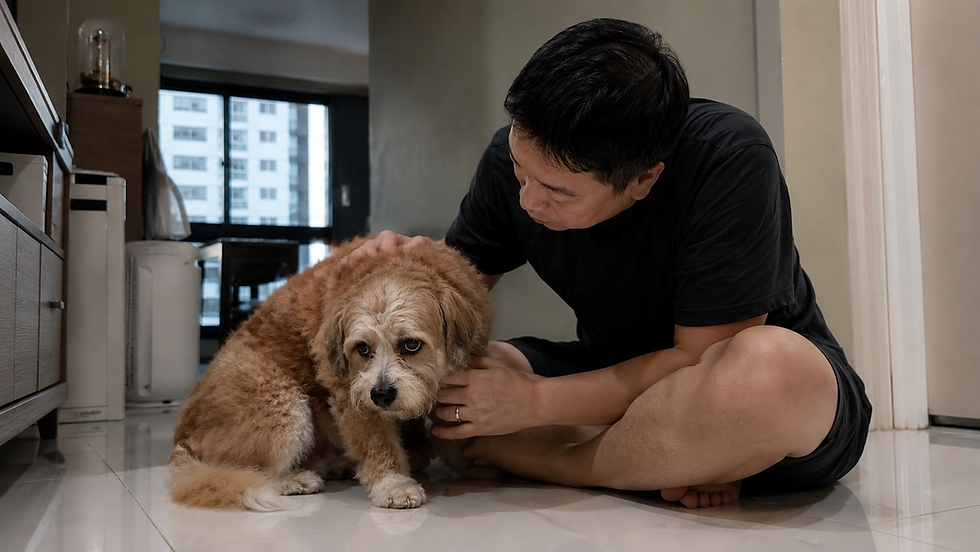
Yes. If your dog seeks comfort from you, it is okay to comfort them.
You've probably heard someone say: "Don't comfort a scared dog because you'll reinforce the fear."
This is fundamentally untrue. As an analogy, if you are sitting on a plane next to someone who is terrified of flying, properly comforting & reassuring them during the flight will not reinforce their fear of flying.
If your dog wants to sit beside you, lean against you or receive gentle physical contact, providing calm reassurance is perfectly reasonable. You don't need to frantically hug them or repeatedly tell them everything is okay.
Remain calm and behave normally. And if your dog prefers to hide alone, respect that choice too.
Use food to change your dog's association with thunder
In some cases, a dog's stress levels are low enough that are still able to eat during storms. If so, high-value food such as tiny pieces of chicken, cheese or another favourite treat. an be extremely useful.
Thunder?
BOOM → chicken.
Another rumble?
BOOM → chicken.
This is called counterconditioning. Over time, thunder begins predicting something the dog loves and gradually, the dog will feel better and better about thunder.
Food also gives us useful information about the dog's emotional state.
If your normally food-obsessed dog suddenly refuses chicken during a thunderstorm, they may already be too frightened for effective training.
At that point, concentrate on helping them feel safe rather than forcing them to participate.
Desensitise your dog to thunder sounds
Long-term treatment of noise fears often involves desensitisation and counterconditioning (DSCC) which your force-free trainer can help you with.
Desensitisation means presenting the frightening stimulus at such a low intensity that the dog notices it without becoming frightened.
For example, on a calm sunny day:
Play a thunder recording on a Bluetooth speaker at a very very low level. Keep the level low enough that it does not bother the dog. THen just keep it playing all day... yes.... all day.
Just like the ticking of a clock in a quiet house, over time, your dog will no longer "notice" the sound. If your dog remains completely relaxed, for the next session, you can increase the volume by one level and then repeat the first step.
The key thing here is to do this gradually.
Don't increase the recording until your dog reacts just to "see how they do."
If your dog becomes frightened, the exercise has become too difficult.
Good desensitisation should actually look rather boring.
Prepare before the thunderstorm arrives
Don't wait until your dog is trembling uncontrollably. Learn their earliest signs of anxiety.
For example, a dog's sequence might look like:
Sky darkens → becomes vigilant → ears go back → starts pacing → hides.
Intervene near the beginning rather than the end.
Dog owners can use forecasts and rain/lightning information from the local Meteorological Service to anticipate thunderstorms.
A typical intervention plan my look like this: The Met Service predicts that thunderstorms are forecast that afternoon.
Before the storm: Take your dog for their toilet walk before the weather deteriorates. Close windows and curtains. Prepare their safe area. Turn on background noise and get high-value treats ready.
As the storm approaches: Bring your dog indoors early. Give them access to their safe space. If your veterinarian has prescribed medication for thunderstorms, follow their instructions regarding timing.
During the storm: Remain calm. Allow your dog to hide or stay beside you. Pair manageable thunder with high-value food if your dog is comfortable eating. Don't force interaction or training.
After the storm: Allow your dog time to decompress. Just because the thunder has stopped doesn't mean their anxiety disappears immediately.
And on sunny days?
That's when you train.
Do ThunderShirts and calming products work for thunder anxiety?
Some dogs appear to benefit from pressure garments such as anxiety wraps or ThunderShirts. They're reasonable to try if your dog is already comfortable wearing clothing. White noise, pheromone products and other calming aids may also help some individual dogs. However, these should generally be viewed as supporting tools rather than cures for serious thunderstorm phobia.
A major scientific review of treatments for canine noise fears found stronger evidence for behavioural interventions and certain veterinary medications than for many nutraceutical, herbal and pheromone products.
If an anxiety wrap helps your dog, use it.
But don't allow calming products to delay appropriate behavioural or veterinary treatment if your dog is experiencing genuine panic.
Does a dog with thunderstorm phobia need medication?
Some dogs do! Medication shouldn't automatically be viewed as a last resort or a failure to train your dog. For dogs experiencing severe thunderstorm phobia, appropriate medication can be one of the most humane components of treatment.
Talk to your veterinarian if your dog:
trembles or pants uncontrollably
shows unprovoked aggression
cannot settle
tries to escape
injures themselves
remains distressed long after storms
becomes progressively more fearful
begins reacting to increasingly subtle storm cues
experiences anxiety frequently enough to affect their quality of life
Veterinary treatment may involve situational medication used around predictable thunderstorms, longer-term anxiety medication or a combination depending on the individual dog.
Medication decisions should always be made by a veterinarian or veterinary behaviourist.
And importantly, the objective shouldn't simply be to make a frightened dog physically quieter. The objective is to reduce the dog's fear and anxiety.
Should I use training or medication for my dog's thunder phobia?
For severe cases, the answer may be:
Both.
A dog experiencing full-blown panic isn't in an ideal emotional state for learning.
Appropriate medication prescribed by a veterinarian may reduce anxiety sufficiently for behaviour modification to become more effective.
Think of treatment as three complementary layers:
Management makes thunderstorms less overwhelming.
Behaviour modification changes how the dog feels about storms.
Veterinary intervention reduces pathological anxiety when necessary.
TLDR: What should I do if my dog is scared of thunder in Singapore?
If you remember nothing else from this article, remember these six things:
Give your dog somewhere safe to hide.
Close windows and curtains and use background noise.
Comfort your dog if they seek reassurance.
Pair manageable thunder with high-value food.
Practise desensitisation and counterconditioning between storms, not when your dog is panicking.
Seek veterinary help if your dog's fear is severe or getting worse.
Most importantly, don't punish frightened behaviour and don't force a terrified dog to "face their fear."
This article is intended for general educational purposes and does not replace veterinary diagnosis or treatment. Medication should only be used under the direction of a veterinarian.


